
University of Kentucky
Beth S. Rous, EdD
Professor
Educational Leadership Studies
40th Annual UCEA Convention · Bridge Conversation
Sustaining Educational Leadership in a Time of Disruption
University of Kentucky

Introductions
University of Kentucky
Professor
Educational Leadership Studies

University of Kentucky
Associate Professor
Educational Leadership Studies
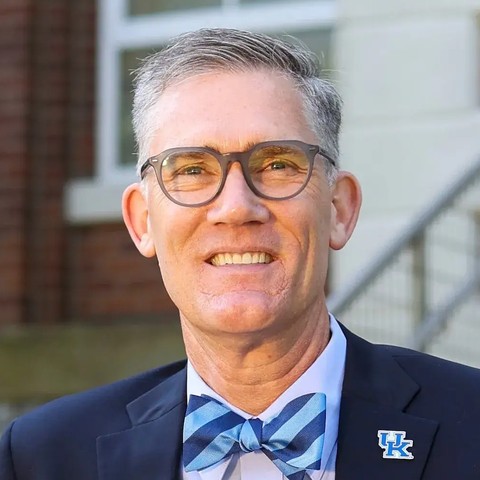
University of Kentucky
Professor
Educational Leadership Studies
Dean, College of Education
In the news
“New state laws land blows against shared governance, tenure”
“Kentucky Senate passes bill making it easier to cut faculty”
“New state laws target DEI, struggling academic programs, and tenure”
Silent reflection
Program decisions shape educational commitments
Program commitments depend on sustainable capacity
What we mean by program stewardship
The collective responsibility to make, sustain, and revise program commitments through transparent, evidence-informed deliberation about students, academic quality, faculty capacity, and public purpose.
Who will teach the required courses next year?
What staffing arrangement can sustain a coherent learning experience without depending on recurring overloads or fragile coverage?
↺ Revisit commitments and conditions, then deliberate again
Changing conditions (political, institutional, resources) bear on educational commitments and public purpose. Inside program stewardship, shared governance (authority and responsibility) and shared leadership (expertise and participation) feed collective deliberation, which uses the Program Stewardship Lens: student commitments, faculty capacity, public and workforce need, academic quality, governance and legal conditions, and institutional structures, examined for evidence, voices, and risks. That leads to program decisions (sustain, redesign, merge, pause, or close), then implementation and review (honor commitments, examine consequences), which loops back to revisit commitments and conditions.
The Program Stewardship Lens
Evidence · Voices · Risks
It supports discussion. It does not produce a score or a decision.
Handout 1Conversation 1 · What is changing, and what follows?
Carry forward: one issue, one changed condition, one obligation
Conversation 2 · Using the lens
Bring to the whole group: one principle, one risk
Application
Program stewardship is educational leadership work.
What can we responsibly promise as conditions change?
40th Annual UCEA Convention · Bridge Conversation
Sustaining Educational Leadership in a Time of Disruption
We’d love to continue the conversation
Beth S. Rous · University of Kentucky
brous@uky.edu · https://www.linkedin.com/in/bethsrous/ (opens in a new tab)
John B. Nash · University of Kentucky
john.nash@uky.edu · https://www.linkedin.com/in/jnash/ (opens in a new tab)
Nicholas J. Pace · University of Kentucky
Nick.Pace@uky.edu · https://www.linkedin.com/in/nickpace (opens in a new tab)
Sources
Read it straight through
The whole session in one place: the framing, the questions, and the tools. Print this page for a clean handout.
Program Stewardship as Bridge Work: Sustaining Educational Leadership in a Time of Disruption. A Bridge Conversation at the 40th Annual UCEA Convention, Pittsburgh, Pennsylvania, Friday, November 20, 2026.
Beth S. Rous, EdD, Professor, Educational Leadership Studies, University of Kentucky (brous@uky.edu; LinkedIn (opens in a new tab)). John B. Nash, PhD, Associate Professor, Educational Leadership Studies, University of Kentucky (john.nash@uky.edu). Nicholas J. Pace, EdD, Professor, Educational Leadership Studies, and Dean, College of Education, University of Kentucky (Nick.Pace@uky.edu; LinkedIn (opens in a new tab)).
Educational leadership programs are navigating political, legal, and institutional disruption, including tenure vulnerability, shifting governance norms, faculty retirements, constrained hiring, enrollment volatility, and program consolidation. This Bridge Conversation frames program stewardship as ethical educational leadership work. Through provocative questions and a Program Stewardship Lens, participants examine how departments can move beyond crisis-driven decision-making toward transparent, evidence-informed, student-centered, and mission-aligned approaches to sustaining, redesigning, merging, pausing, or closing programs responsibly.
The central question for the hour: What can we responsibly promise and sustain as conditions change?
This is a national leadership problem, not a local departmental one. Educational leadership programs are being asked to make decisions about program futures in a period of significant disruption. In many states and institutions, the assumptions that once held academic programs steady (tenure protections, shared governance norms, predictable faculty replacement, and departmental autonomy) are being reconsidered, narrowed, or restructured. At the same time, many educational leadership departments face retirements, enrollment volatility, constrained hiring, program consolidation, online competition, and questions about whether existing program portfolios can be sustained.
The rules of academic work are changing while decisions are being made. Recent headlines: “New state laws land blows against shared governance, tenure” (Quinn, Inside Higher Ed, 2026); “Kentucky Senate passes bill making it easier to cut faculty” (Higher Ed Dive, 2026); “New state laws target DEI, struggling academic programs, and tenure” (The Chronicle of Higher Education, 2025).
These pressures often appear as technical questions. Who will teach required courses? Which programs have enough enrollment? Can faculty lines be replaced? Should programs be merged, paused, or closed? They are also ethical and public questions. What do departments owe students when programs were built under one set of conditions but must now be sustained under another? How should faculty take part in decisions when governance structures are shifting? What responsibilities do educational leadership programs have to the schools, districts, communities, and public systems they serve?
What program sustainability question is your unit avoiding or circling around?
Write quietly. Note what is changing and who is affected. You choose what to share later.
Decisions about staffing, enrollment, resources, and organizational structure also shape what a program can provide, whose needs it serves, and which forms of knowledge and professional preparation it sustains. Gumport’s (2000) analysis of academic restructuring highlights the tension between responding to economic pressures and sustaining higher education’s educational and democratic purposes. That invites us to examine program futures through both resource realities and public responsibilities.
Framing question: What educational commitments are at stake in the program decisions we face?
Shared governance concerns the distribution of authority and responsibility among governing boards, administrators, and faculty. The AAUP’s 1966 statement identifies faculty’s primary responsibility for academic matters and calls for faculty participation in institutional planning and resource priorities.
Shared leadership concerns how people contribute expertise and exercise leadership across roles. It requires conditions that support meaningful contributions, including access to information, clear responsibilities, and organizational support (Holcombe & Kezar, 2017; Kezar & Holcombe, 2017).
For program deliberation, we need to clarify both who has authority to decide and how relevant knowledge and perspectives will shape the decision.
Framing question: Who can shape the options before a recommendation is made, and who is accountable for the decision?
Consider the full work required to sustain a program: teaching, advising, dissertation supervision, coordination, assessment, recruitment, and relationships with practitioners and communities. A program may keep operating while depending on recurring overloads, unrecognized labor, or expertise concentrated in one person. Examining these arrangements helps us consider whether current commitments can be maintained, and what would need to change.
Framing question: What does it actually take to deliver the learning experience we promise, and can that work be sustained?
Program stewardship: the collective responsibility to make, sustain, and revise program commitments through transparent, evidence-informed deliberation about students, academic quality, faculty capacity, and public purpose.
Program management asks how the work will operate. Program stewardship also asks whether the commitments are responsible and sustainable over time. Responsible program decisions require both. For example, the management question “Who will teach the required courses next year?” sits beside the stewardship question “What staffing arrangement can sustain a coherent learning experience without depending on recurring overloads or fragile coverage?”
Stewardship can lead to sustaining, redesigning, merging, pausing, or closing a program. Each option requires attention to its consequences and to the commitments that come with it.
Framing question: What can we responsibly promise under the conditions we face?
Changing conditions (political, institutional, and resource conditions) bear on a program’s educational commitments and public purpose. Inside program stewardship, shared governance (authority and responsibility) and shared leadership (expertise and participation) feed collective deliberation. Deliberation uses the Program Stewardship Lens and leads to a program decision: sustain, redesign, merge, pause, or close. Implementation and review follow: honor commitments and examine consequences. Then the unit revisits its commitments and conditions and deliberates again.
The lens brings six dimensions into the conversation. Across them, ask: What evidence do we need? Whose perspectives should inform the decision? What risks arise from acting, or from waiting? The lens helps identify what deserves attention and what needs further inquiry. It supports a reasoned decision and an explicit account of how commitments will be honored. It does not produce a score or an automatic decision.
| Dimension | Questions for deliberation |
|---|---|
| Student commitments | What have we promised current and prospective students? Can we support timely completion, advising, required courses, and a coherent learning experience through any transition? |
| Faculty capacity | What teaching, advising, supervision, and coordination can faculty sustain? Where do we rely on overloads, unrecognized labor, or one person’s expertise? |
| Public and workforce need | Whom does the program serve, and what evidence shows continuing need? Who would lose access or opportunity if it changed or ended? |
| Academic quality | What learning and professional preparation must remain intact? What do student work, assessment findings, and accreditation or licensure expectations tell us? |
| Governance and legal conditions | Who has authority to recommend, approve, and implement change? How will faculty and affected groups participate? What policies or requirements must be verified? |
| Institutional structures | How do resources, hiring, budgets, delivery arrangements, and organizational location shape the options? What support or commitments would each option require? |
Keep the same group and the same issue across both conversations where you can. Use one member’s question or a shared concern. Discuss without identifying colleagues, students, or institutions.
Choose an issue and consider: What can no longer be assumed? What do we owe students, faculty, and the public under these conditions? When could continuing unchanged cause harm, and what harms could change cause? Carry forward one program issue, one changed condition, and one obligation. Keep this brief so there is time to apply the lens.
Scan all six dimensions of the lens and focus on the two or three that matter most for your issue. Discuss what evidence is available or missing, whose perspective is needed, and the risks of acting or waiting. Prepare one stewardship principle and one decision-making risk for the whole group, using the response fields on Handout 1.
Each group shares one stewardship principle and one decision-making risk. As themes collect, we ask what recurs, what is missing, and where context matters. For a few themes, we ask: What practice or safeguard would make this principle visible? Unresolved tensions stay on the table rather than being forced into agreement.
Use Handout 3. Choose one question to take back to a faculty meeting, retreat, program review, teach-out plan, or restructuring discussion. Name the people or forum needed, and one next step within your role.
Program stewardship is educational leadership work. What can we responsibly promise as conditions change?
Questions, evidence, voices, and potential consequences to consider in program decisions (Handout 4).
| Stewardship question | Evidence to examine | Voices to include | Risk if ignored |
|---|---|---|---|
| What are we promising students? | Program requirements, advising patterns, time to degree, course rotations, licensure or certification pathways, teach-out obligations | Current students, alumni, advisors, faculty, staff | Students carry the burden of institutional uncertainty |
| What can faculty sustain responsibly? | Workload, retirements, course demand, advising load, dissertation supervision, program leadership roles, faculty title series | Faculty across title series, chairs, program leads, staff who support students | Hidden labor, resentment, uneven quality, burnout |
| What public need does the program serve? | Workforce demand, state or regional needs, employer feedback, community needs, licensure or certification expectations | Practitioners, partners, alumni, state or district leaders, community representatives | Program identity becomes inward-facing |
| What academic quality must be protected? | Curriculum coherence, student learning outcomes, accreditation expectations, faculty expertise, assessment data | Faculty, students, accreditors, external reviewers, program completers | Sustainability decisions weaken program integrity |
| What governance and legal conditions shape the decision? | State policy, tenure protections, shared governance rules, financial exigency or program discontinuance policies, institutional restructuring processes | Faculty governance bodies, chairs, deans, provost’s office, legal and policy staff | Decisions are made without procedural clarity or trust |
| What institutional structures make the plan possible or impossible? | Budget model, hiring timelines, faculty line allocation, enrollment strategy, online strategy, college-level priorities | Dean’s office, department, college staff, central administration | Faculty make plans that cannot be implemented |
American Association of University Professors. (1966). Statement on government of colleges and universities. https://www.aaup.org/reports-publications/aaup-policies-reports/topical-reports/statement-government-colleges-and
American Association of University Professors. (n.d.). Shared governance.
Gumport, P. J. (2000). Academic restructuring: Organizational change and institutional imperatives. Higher Education, 39(1), 67–91. https://doi.org/10.1023/A:1003859026301
Higher Ed Dive. (2026, March 27). Kentucky Senate passes bill making it easier to cut faculty. https://www.highereddive.com/news/kentucky-senate-passes-bill-making-it-easier-to-cut-faculty/816039/
Holcombe, E., & Kezar, A. (2017, May 10). The whys and hows of shared leadership in higher education. Higher Education Today. https://www.higheredtoday.org/2017/05/10/whys-hows-shared-leadership-higher-education/
Kezar, A. J., & Holcombe, E. M. (2017). Shared leadership in higher education: Important lessons from research and practice. American Council on Education.
Quinn, R. (2026, April 30). New state laws land blows against shared governance, tenure. Inside Higher Ed.
The Chronicle of Higher Education. (2025, May 5). New state laws target DEI, struggling academic programs, and tenure. https://www.chronicle.com/article/new-state-laws-target-dei-struggling-academic-programs-and-tenure